
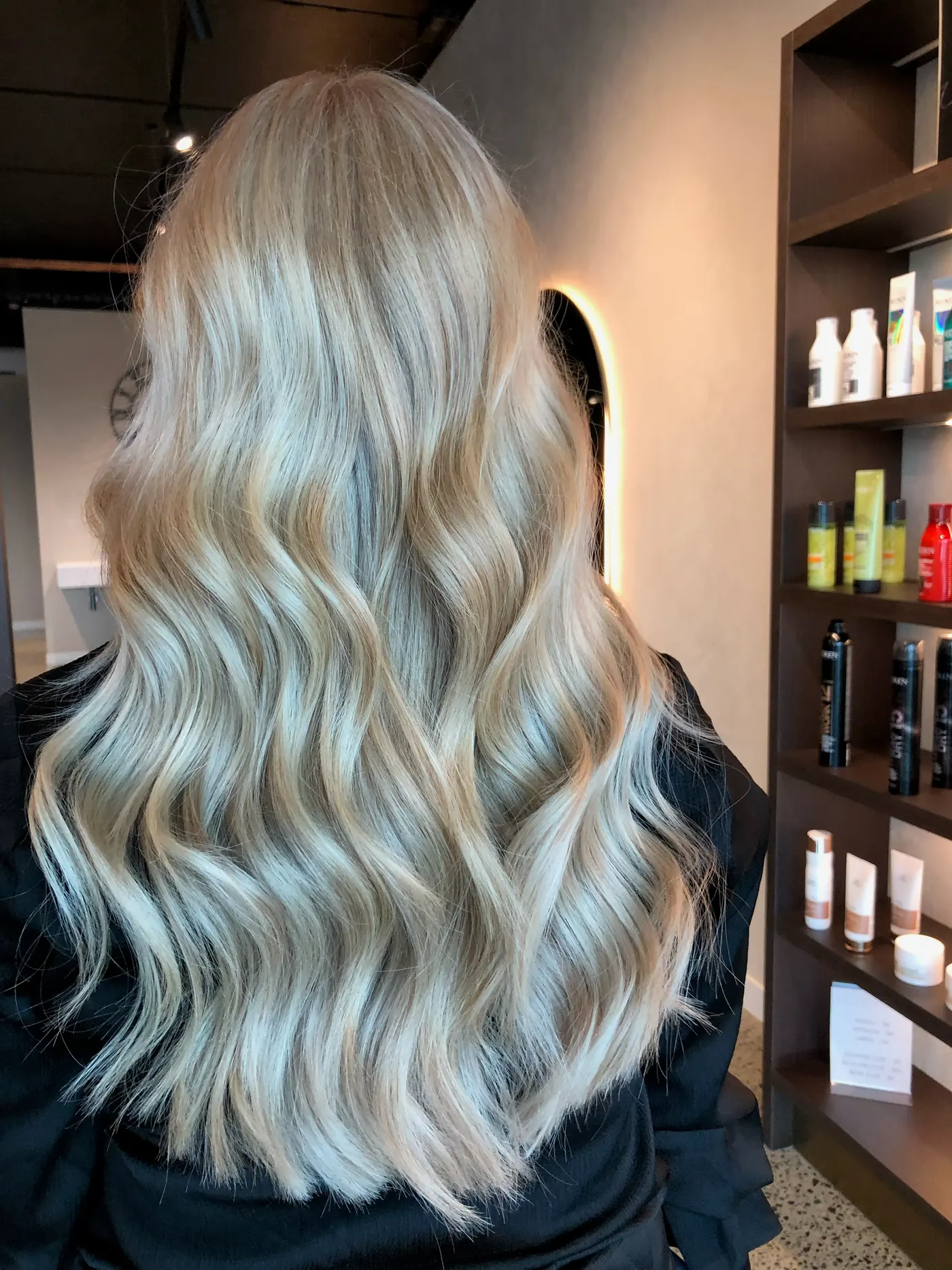
Part of the treatments and smoothing guides. Start with Keratin and smoothing treatments in Auckland: what they do, what they cost and how long they last, or see treatments and smoothing in the salon.
What a bond is
Hair gets its strength from disulphide bonds, chemical links between the protein chains inside each strand. They're what let hair stretch and spring back, hold a curl, and survive a brush. Lightener breaks some of them every time it works, because opening the hair to remove pigment means opening those links too. Heat breaks more. Broken bonds are why lightened hair can feel stretchy when wet, snap when dry, and lose its shine.
What bond builders do
A bond builder carries an active ingredient that reconnects broken disulphide bonds, or stabilises the ones that are left, so the hair keeps its structure through and after lightening. Olaplex made the category famous, and every professional brand now has its own version. Used in the salon during a lightening service, a bond builder lets the hair lift further in 1 sitting with less loss of strength; used at home, it keeps the repair going between visits.
Keratin or bond repair?
The question our stylists are asked most about treatments, and the answer is that they do different jobs. Bond repair works inside the hair for strength and elasticity. Keratin smoothing works on the outside, sealing the cuticle for smoothness and frizz control. A blonde whose hair feels weak needs bond repair. A blonde whose hair is strong but frizzy needs smoothing. A blonde with both, which is most blondes in a Coast summer, uses bond repair during and after the lightening and a smoothing treatment for the finish.
When to use bond repair
- During any lightening service, added to the lightener or applied straight after, so the bonds are rebuilt as they're broken.
- Between the stages of a dark-to-blonde plan, where each lift asks more of the hair than the last.
- After heat damage: daily straightening, a summer of hot tools, or a blow wave that's been pushed too hot.
- Before a big colour change, so the hair arrives at the appointment strong enough for the plan.
In the salon and at home
In the salon at Jenna Ellen Hair, the deeper repair is Kérastase Premiere ($70), applied at the basin as a 2-step treatment. At home, the retail wall carries the Kérastase, Redken and O&M bond-care shampoos, masks and leave-ins the stylists use, and a weekly bond mask is the routine that keeps the in-salon repair going.
Kérastase Premiere, explained
Premiere works on a finding Kérastase built the range around: damaged hair accumulates calcium from water, which stiffens the fibre and blocks repair from getting in. Premiere's first step lifts that calcium out; the second step rebuilds the fibre with a repairing complex. The hair leaves stronger, softer and more even, and it takes colour and toner more evenly afterwards, which is why it's the treatment before a toner on hair that's been struggling to hold one.
Signs your hair needs it
Hair that stretches when wet and doesn't spring back. Ends that snap rather than split. Blonde that's lost its shine and feels rough between the fingers. A toner that fades in a fortnight. Any of those is the cue to add Premiere to your next visit and a bond mask to the weekly routine.
The routine
Premiere at every lightening visit while the hair is being lifted; a Fusio-Dose ($50) at the visits between for maintenance; a bond mask once a week at home; and a heat protectant before every hot tool, because preventing the break is cheaper than repairing it. The blonde care routine covers the rest.